Case Study
Content Creator
In ProgressAn AI content engine for high-retention, motivational short-form video.
- Stack
- Next.js · React · TypeScript · Tailwind CSS · Zod · Anthropic SDK · OpenAI SDK
Overview
Content Creator is an AI-powered application focused on generating motivational short-form video scripts — Reels, Shorts, and similar formats. It's designed from the perspective of someone who is also a content creator: the product exists because the problem is a lived one.
Problem
Writing a motivational short-form script that actually holds attention — a real hook, an emotional arc, a payoff, a clear call to action — takes real craft and real time, repeated for every single piece of content.
Solution
A structured input turns into a structured script through a defined pipeline:
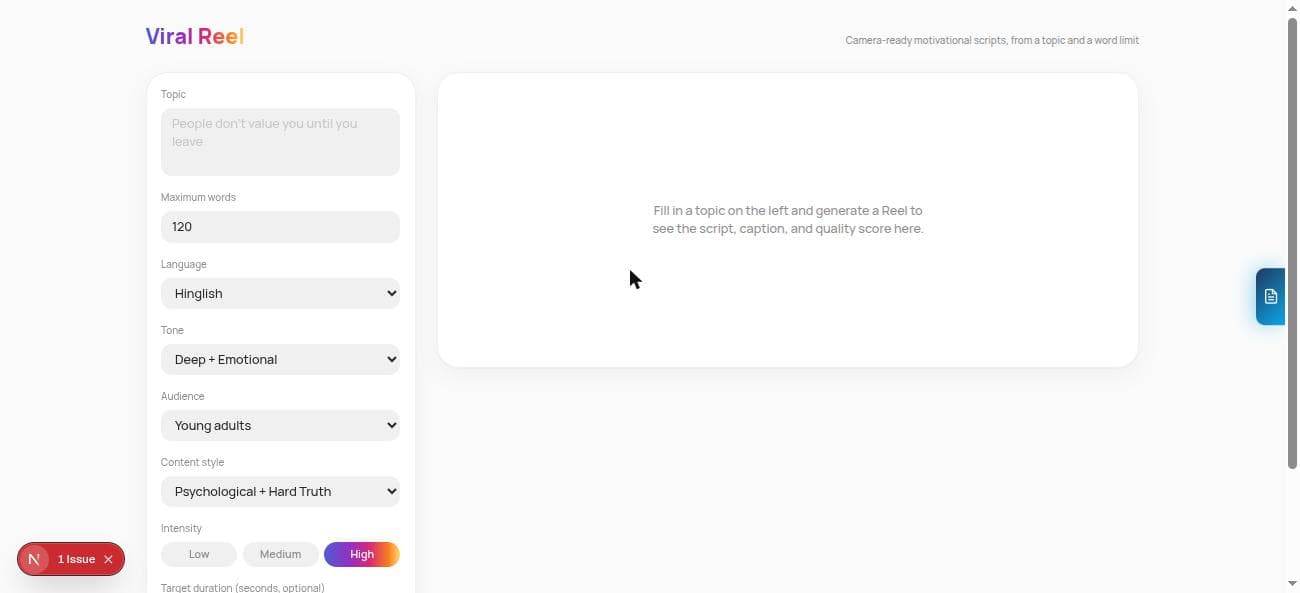
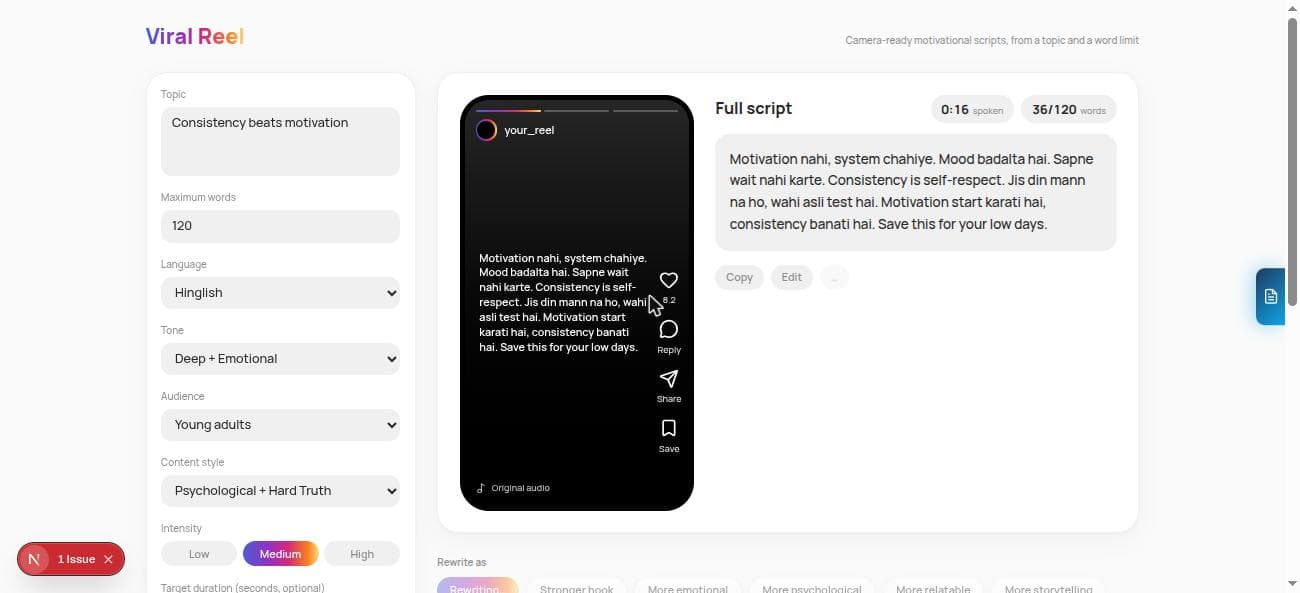
Input: Topic, Maximum Words, Language, Tone, Audience, Style
AI Content Engine produces, in order:
- Hook
- Body
- Emotional Build
- Core Insight
- Climax
- Closing Hook
- CTA
- Caption
- Hashtags
The output is optimized for retention, engagement, shareability and saveability — never sold as a guarantee of virality.
Key Features
- Structured input → structured script pipeline (see Solution above)
- An interactive workspace, not a one-shot generator: each beat — Hook, Setup, Emotional Shift, Core Insight, Climax, Closing Hook, CTA — can be individually regenerated or rewritten after the first draft
- A quality-scoring panel surfaces feedback on the generated script
- Multi-provider AI backend — Anthropic and OpenAI supported behind one swappable interface, so no single vendor is a hard dependency
- Output is schema-validated, with an automatic repair pass if the model returns something malformed — nothing downstream trusts raw model output directly
- Hard word-limit enforcement as its own pipeline stage, not left to prompt instructions alone
- Rate-limited generation API
- Built by a creator, for the creator's actual workflow
Architecture
A small monorepo, cleanly split by responsibility:
web— the Next.js app: the workspace UI (form, beat cards, score panel, rewrite bar) and two API routes,/api/reels/generateand/api/reels/transform.ai-service— the pipeline itself, independent of the web layer: hook selection → LLM generation → schema validation (with one repair retry) → word-limit enforcement → quality-score normalization → post-processing. Every stage re-checks what the previous one produced.prompts— versioned prompt templates, referenced by version so a prompt change doesn't silently affect output shape elsewhere.
The LLM call itself sits behind an ILlmProvider interface, with
concrete Anthropic and OpenAI implementations (and a mock provider for
development without live API calls) — swapping or adding a model
provider doesn't touch the pipeline logic.
Technology
Next.js 16, React 19, TypeScript, Tailwind CSS, Zod for schema validation throughout, the Anthropic and OpenAI SDKs, npm workspaces for the monorepo.
Development Approach
Built using an AI-assisted development workflow (AIDLC) — Claude Code, Kiro and Amazon Q accelerate implementation, while architecture, decisions and quality remain owned by the developer.
Decisions & Trade-offs
Two decisions are visible directly in the architecture: word-limit compliance is enforced programmatically rather than trusted to the prompt, and the LLM layer is provider-agnostic from the start rather than hard-coded to one vendor — both add a pipeline stage of complexity in exchange for output that's actually reliable rather than usually right.